

Inside this issue
Scroll down to browse the excerpts below or simply click the article link in the table of contents to read the full article--no login is required!
Cover Story | |
Featured Articles
| |
Columns | |
Articles |
Cover story
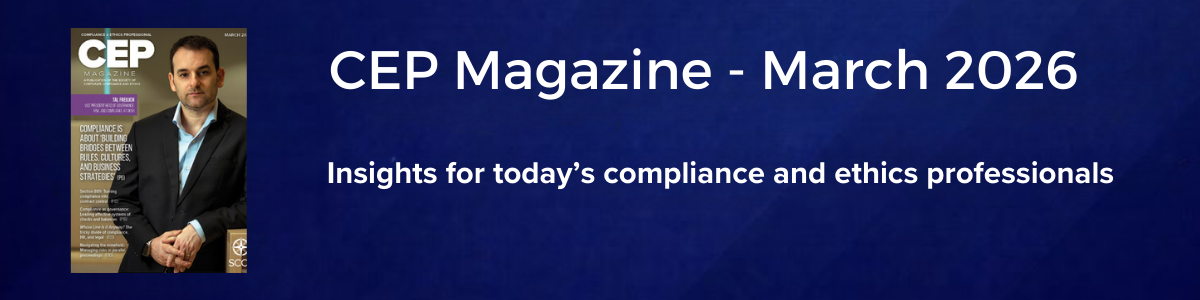
Meet Tal Freilich: Compliance is about ‘building bridges between rules, cultures, and business strategies’
AT: Thanks for taking the time to talk with us. I've enjoyed our previous conversations and the podcast we recorded. I m glad we have some extra time to get into things. You ve had an interesting career, working in multiple industries and around the globe. What s driven your career path? Were you looking for something different, or did the opportunities just arise?
TF: My career path has been a blend of curiosity, opportunity, and a passion for building trust through governance and compliance. I never set out with a rigid blueprint, but I was always driven by the belief that compliance can be more than a safeguard; it can be a genuine differentiator for organizations.
Featured articles
[CEU] Section 889: Turning compliance into contract control
Section 889 of the Fiscal Year 2019 National Defense Authorization Act completely changed the landscape of federal contracting.1 What many first dismissed a narrow ban on specific telecommunications equipment ended up exposing deep cracks in how organizations manage vendor compliance and supply chain integrity.
Compliance as governance: Leading effective systems of checks and balances
For most corporate executives, the question “Who owns corporate compliance?” seems simple: the chief compliance officer (CCO). That’s why that role exists: to keep the organization on the right side of ever-shifting regulatory demands.
[CEU] Whose Line Is It Anyway? The tricky divide of compliance, HR, and legal
Picture this: An employee reports a manager for making inappropriate comments during a team meeting. Within minutes, three different departments are CCed on the email chain. Legal wants to assess litigation risk. Human resources (HR) wants to review the personnel file. Compliance wants to check if this violates the code of conduct. By the end of the day, the employee has been contacted by four different people asking the same questions, each department has started its own file, and nobody’s quite sure who’s actually running the investigation.
[CEU] Navigating the minefield: Managing risks in parallel proceedings
In today’s regulatory environment, companies rarely face a single, isolated investigation. Instead, it has become increasingly common for organizations and their employees to find themselves at the intersection of multiple, overlapping legal proceedings — criminal, civil, and administrative. For compliance
professionals, this growing trend presents substantial risks and strategic challenges. Issues that begin as a narrow civil matter may quickly expand, drawing the attention of criminal prosecutors, regulatory agencies, or even private litigants.
Columns
AI in compliance: Why technology alone won’t solve the risk
AI is no longer an emerging issue for compliance programs; it is a defining one. Among the top global compliance concerns in 2026, AI stands out not simply because of its power but because of the scale of change it introduces. The real risk is not that organizations adopt AI too slowly, but that they adopt it without managing the human, cultural, and governance shifts that come with it.
Jevons paradox is coming for compliance — and that’s a good thing
Here’s a question that should keep you up at night: What if the reason your compliance program feels perpetually under resourced isn’t a budget problem; it’s a demand problem you haven’t even begun to solve?
Beyond dashboards: Turning behavioral signals into board foresight
Boards and compliance leaders often talk past each other because they rely on different kinds of evidence about risk. Compliance teams sit closest to behavioral “weak signals,” but those signals may be converted into abstract metrics that boards struggle to interpret or use. A behavioral lens can help turn those weak signals into clear,practical foresight for directors.
Code of . . . what?
Whether you name it the code of ethics, code of conduct, or code of ethics and conduct, it guides employees on how to behave, helps decision making, fosters a positive workplace culture, and protects the company’s reputation.
Beyond the checklist: Measuring what really matters in compliance
In recent years, compliance programs in Asia–Pacific (APAC) have grown more sophisticated, moving from reactive enforcement to proactive risk management. But even the most well-structured program can lose momentum if it can’t answer a simple question: Is it working?
Articles
Why is compliance being asked to run records management programs?
The corporate world is seeing an interesting shift: increasingly, corporate compliance teams are being handed ownership of records management programs. This
might raise a few eyebrows. After all, records management has traditionally been run by the legal department, often as a component of legal or regulatory
compliance. Legal teams historically oversaw records retention schedules and policies, given their focus on meeting regulatory requirements and preparing for litigation.
Compliance programs: The invisible insurance
The evolution of compliance programs from “check-thebox” to a human-centric, proactive approach represents a fundamental shift in corporate governance.1 The demand for greater transparency in governance has elevated the function of the program from a rule-based approach to a culture-driven motivation framework.
Always-on compliance: Building a 24/7 view of risk
In a world of real-time transactions, instantaneous communication, and global operations, compliance can no longer rely on regularly scheduled assessments. Issues and violations emerge fast and need to be dealt with even faster. Teams can no longer simply rely on traditional auditing and case review cycles.
Rewriting compliance rules for employee crypto trading
As digital assets evolve from fringe technologies to mainstream investment tools, they’re changing more than just markets. They’re also reshaping how employees interact with financial systems across organizations. Personal crypto trading has become a regular activity among staff at all levels, introducing new risks that compliance programs must manage with urgency and precision.